ar in aerospace
Augmented Reality in Aerospace: Smarter Design, Safer Operations
AR/MR overlays real‑time data on the physical world to transform training, maintenance, and system design.
Engineers, pilots, and technicians can visualise components, simulate operations, and reduce errors. From cockpit simulations to assembly guidance, AR/MR boosts safety, efficiency, and innovation across aerospace.
- Smarter design
- Safer operations
- Faster training
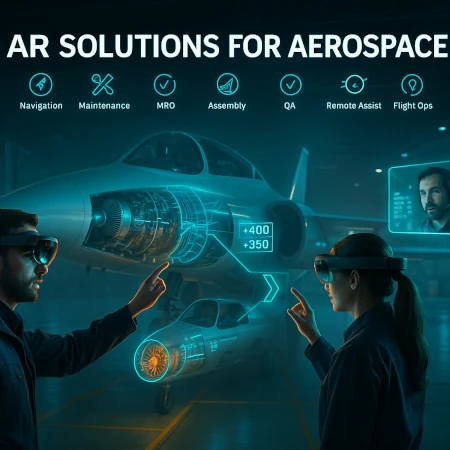
Applications of MR in Aerospace
Overlay live, holographic data on the real world to design faster, train safer, and operate smarter.
Aircraft Design & Prototyping
Interact with 3D holographic models and collaborate globally.
- Real‑time design reviews in MR
- Fewer physical prototypes
- Shorter design‑to‑production cycle
Pilot Training & Simulation
MR cockpit overlays for realistic drills and emergencies.
- Weather & system failure scenarios
- Better reaction time and decision‑making
Aircraft Maintenance & Repair
Hands‑free repair guides and schematics on headsets.
- Step‑by‑step instructions
- Higher precision, less downtime
Airport Ops & Air Traffic Mgmt
Live flight data, weather, and positions overlaid for control and ground ops.
- Refuelling & baggage optimisation
- Passenger wayfinding with MR
Space Exploration & Training
Simulate zero‑G tasks and interact with virtual panels.
- Prepare for spacewalks & emergencies
- Better in‑mission decision‑making
Passenger Experience & In‑Flight
Immersive safety demos and interactive experiences.
- Airport MR directions
- Virtual seat selection & guides
Augmented Reality in Aerospace Maintenance — Process
A clear, guided flow that reduces errors and aircraft downtime.
1
Assess & Identify
Scan tail/serial; pull job cards, history, and AD/SB data.
2
Access Guides
Load MR procedures, torque specs, tooling lists, and safety notes.
3
Overlay & Execute
See holographic callouts on the airframe; hands‑free steps with voice/gesture.
4
Verify & QA
Guided inspection, torque validation, photo/video capture for proof.
5
Log & Sync
Auto‑log actions and sync with MRO/ERP for sign‑off and analytics.
Case Studies
Real outcomes from MR deployments in aerospace.
MR in Aircraft Maintenance
Hands‑free guidance for complex repairsChallenge
Engineers required guided overlays for intricate tasks.
Solution
MR headsets projecting interactive repair instructions on components.
Outcome
Maintenance errors reduced and repair speed improved by ~30%.
MR Cockpit Training for Pilots
Lower‑cost, high‑fidelity trainingChallenge
Traditional simulators were costly and limited.
Solution
MR cockpit with interactive instruments and flight controls.
Outcome
Training costs reduced while readiness and reaction time improved.
MR Prototyping for Engineering
Collaborative design across locationsChallenge
Teams needed faster, shared prototyping workflows.
Solution
Interactive 3D models refined in real time in shared MR.
Outcome
Prototyping time reduced by ~40% and material waste minimised.
Augmented Reality in Aerospace: Smarter Design, Safer Operations
Bring holographic guidance to engineering, flight ops, and MRO with scalable AR/MR solutions.
Tags :